Article
Helping People With Aphasia Sound Like Themselves Again
Aphasia is widely misunderstood.
It does not affect intelligence. It does not remove personality. But it can take away something deeply personal: the ability to communicate naturally.
After a stroke or brain injury, many people know exactly what they want to say, yet struggle to find or produce the words. When speech does come, it may no longer sound like them.
That loss of voice is also a loss of identity.
Why This Became Personal
My interest in this space is not abstract.
My father had a stroke and developed aphasia. Over time, communication has become harder for him, not because he does not know what he wants to say, but because getting the words out is exhausting.
Watching that happen is sobering. It is frustrating too, mostly because it feels unfair.
You start to notice things you did not notice before. How quickly conversations move on. How often people fill silence. How much confidence is tied to being able to speak fluently.
That changes how you think about technology. It sharpens your sense of responsibility. It makes very clear what actually matters when communication breaks down.
The Problem With Most Assistive Tools
There are many communication aids available, and some are genuinely helpful.
But many fall into one of two traps.
The first is cognitive overload: too many options, too much text, too much choice for someone whose language processing is already under strain.
The second is loss of identity: generic voices, unnatural pacing and interfaces that make the user feel like they are operating a machine rather than speaking as themselves.
I tried several existing tools with my father. Some worked briefly, but I kept seeing the same pattern: hesitation, backtracking or abandonment halfway through. The issue was not capability. It was friction.
For someone with aphasia, communication is not just about being understood. It is about being recognised as who they are.
That distinction shaped every design decision.
A Human-First Design Principle
I kept coming back to one idea, even when it made things harder to build:
The technology should adapt to the person, not the other way around.
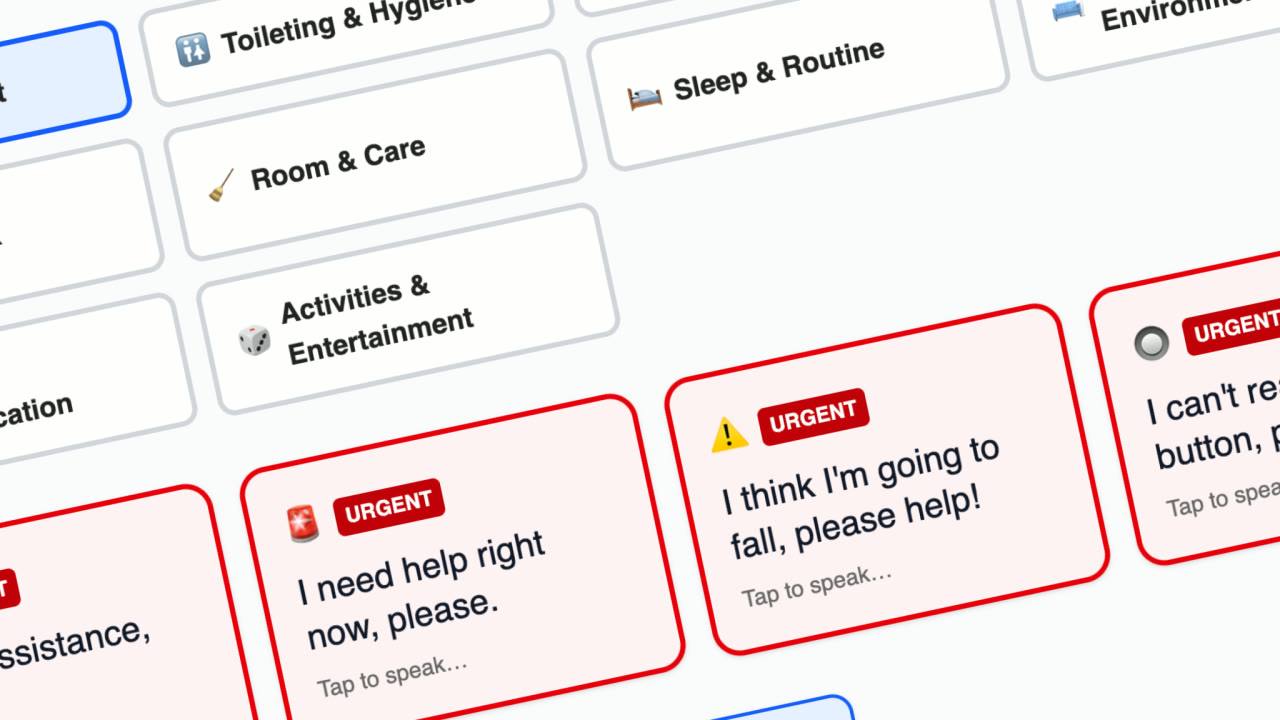
In practice, that means short, meaningful phrases. Predictable layouts. Minimal steps between intent and speech. No clever gestures. No hidden interactions.
Familiarity beats novelty every time.
It also means accepting that this is not a tool for fluent typing. It is a scaffold: something to lean on when word-finding is difficult and confidence is fragile.
The goal is not speed. It is reducing friction at the exact moment communication becomes hard.
Supporting Different Ways Of Expressing Intent
People with aphasia do not communicate the same way all the time. The app reflects that.
Sometimes it is speaking naturally. Sometimes it is typing a single word. Sometimes it is drawing a shape or symbol when language will not come.
In each case, the system's role is not to take over. It is to offer a small number of natural conversational options, then step back.
The user stays in control of what is said and how it is said.
Why I Chose A PWA
Building this as a Progressive Web App was deliberate.
PWAs work across phones and tablets without app-store friction. They can be installed, pinned and launched quickly. They update quietly. They work in care homes, hospitals and domestic settings without specialist hardware or accounts.
Just as importantly, PWAs let me focus on accessibility and reliability rather than platform-specific polish.
When building for people with cognitive or speech challenges, consistency matters far more than novelty.
Where AI Helps And Where It Does Not
AI is part of this project, but it is not the headline.
Used carefully, it can help interpret intent, reduce effort and, in some cases, restore something deeply personal: a familiar voice.
Voice cloning was the hardest decision I made. I hesitated for weeks before enabling it. Hearing your own voice again is not a novelty. It carries real emotional weight.
With explicit consent, training audio can be sourced from family videos or old recordings and used to produce speech that sounds familiar rather than synthetic. Even short phrases can be profoundly emotional.
This is also where restraint matters most.
AI is optional. It is contextual. It is never the point of the app.
Nothing is automated in a way that removes agency or increases cognitive load. If AI makes the experience more complex, it does not belong there.
A Deliberate Technical Approach
The architecture mirrors the interface: calm, predictable and respectful of the user.
The app is an offline-first PWA using modern web technologies, with service workers for resilience and intelligent caching to reduce latency.
Speech capture uses the Web Audio API with noise suppression and auto-gain control, which matters in care environments where background noise is unavoidable.
Conversation history is intentionally short. Just enough context to feel natural. Never enough to overwhelm.
API keys are never stored server-side. Users provide their own OpenAI or ElevenLabs credentials, stored locally in the browser. Calls are made directly from the client, so control stays with the user.
That decision was not just technical. It was ethical.
Ethics Are A Responsibility
Working in assistive technology forces you to confront questions that are easy to avoid elsewhere.
Who controls the data? How is consent given, and revisited over time? What happens when someone's condition changes? What should not be built, even if it is technically possible?
These are not edge cases. They are central.
My guiding principle has been simple: if I would not be comfortable using this tool for someone I love, it does not ship.
What This Project Taught Me
Good technology leadership is not about using the most tools.
It is about knowing when not to reach for them.
In this case, success was not sophistication. It was calmness. Reduction. The absence of friction. Whether the tool could fade into the background and let the person come forward again.
It also reinforced something I already believed: pragmatic AI, applied carefully and ethically, has a place. Not everywhere. Not always. But here, used with restraint, it can genuinely help.
This is not a finished product, and it may never be. It is living work shaped by real people, real constraints and real responsibility.
But if it does one thing well, if it helps someone with aphasia sound like themselves again even briefly, then every careful decision is worth it.
Sometimes the most meaningful technology does not need to shout.
Need senior support on a web project?
Bring in focused technical help for planning, build, review or long-term support.